Body interlining: what actually holds a jacket front up
Body interlining is a medium-weight fusible used across the body of a garment; in 55 and 65 g it gives a form that stays up rather than collapsing. Here is how to pick the weight, the order of the layers in a jacket front, and what has to happen before you fuse anything.
UB-BT150 Updated
What is body interlining?
Body interlining is, as the name says, the fusible used across the body of a garment. What separates it from paper interlining, which goes on small parts like collars and cuffs, is that it is built to cover an area: it is more flexible, it drapes better, and its weight is set for that job.
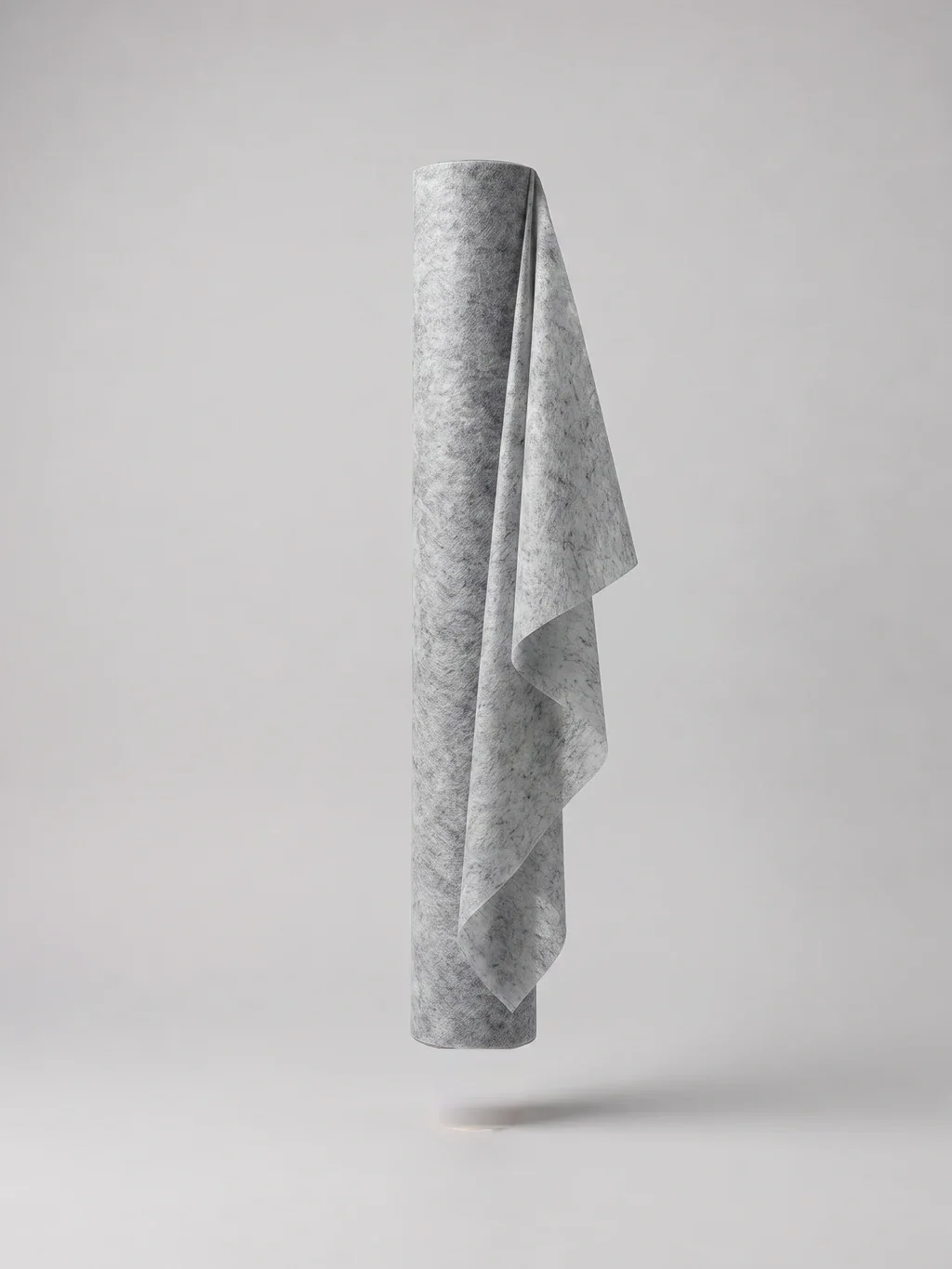
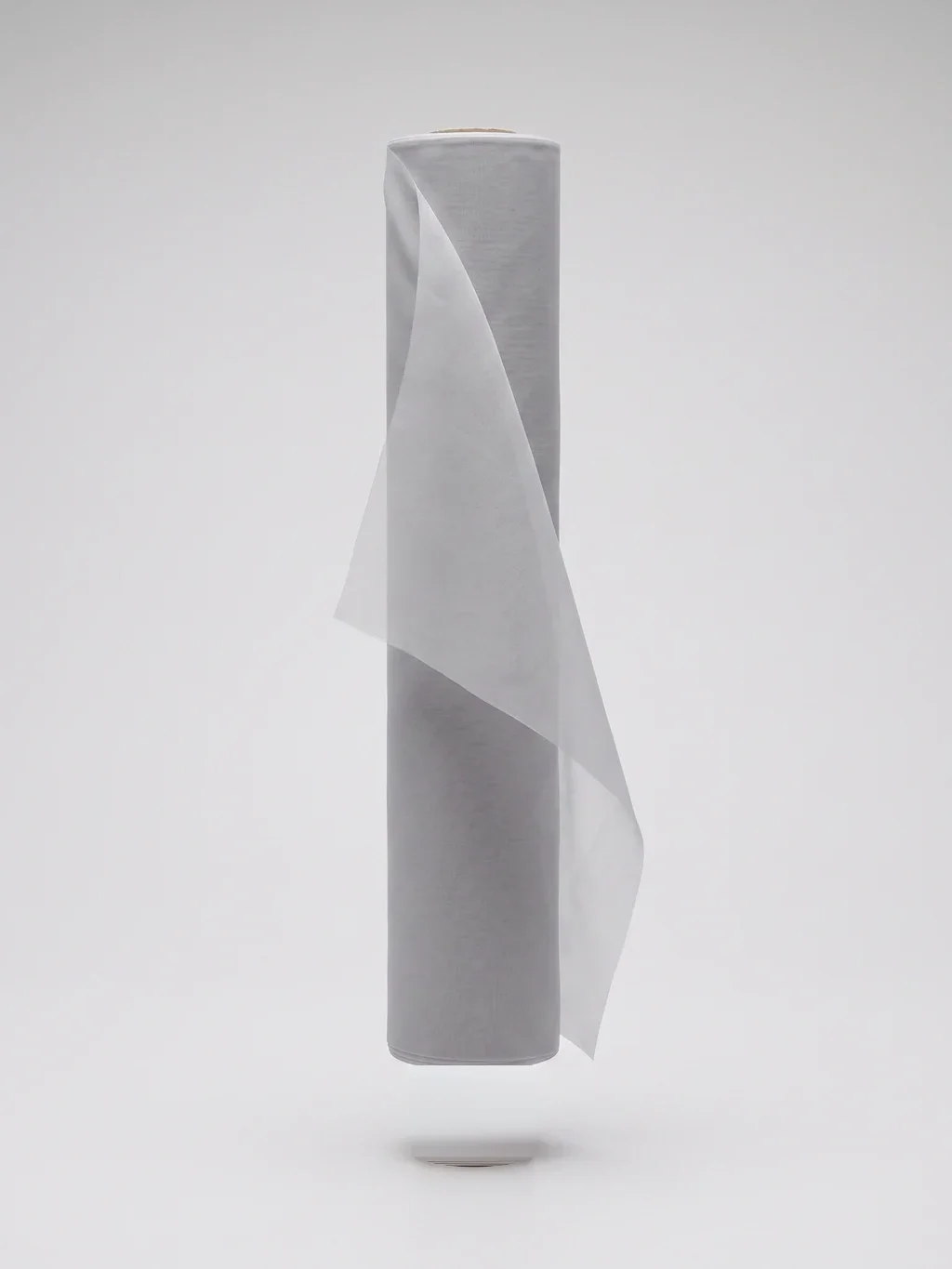
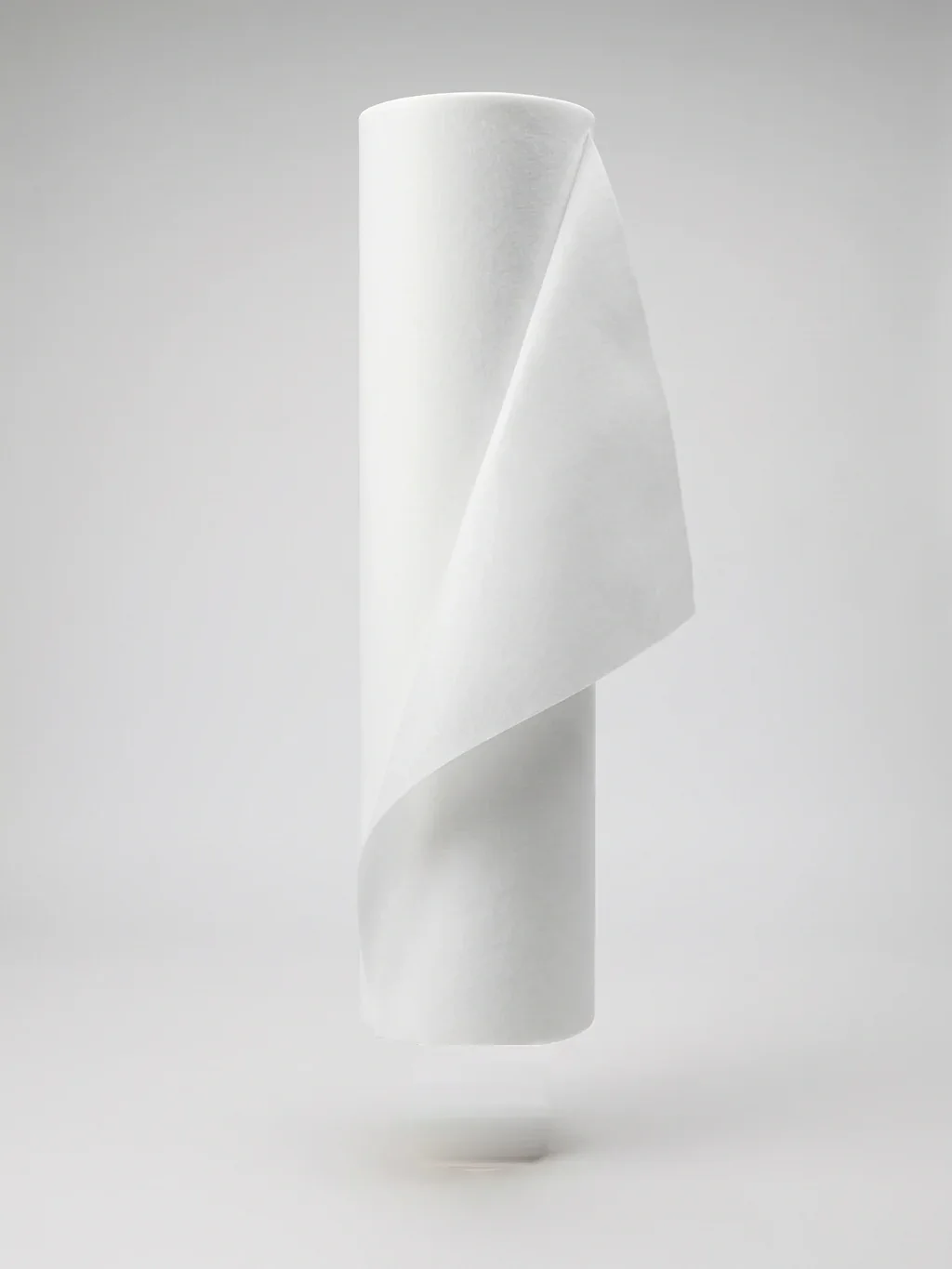
It comes in two weights, 55 and 65 g. 150 cm wide, in 100-metre rolls, in the tones shown plus white.
Most of what we call the "shape" of a jacket comes from here. Cloth on its own does not run cleanly down from the shoulder; for a front panel to stand up by itself it needs a support layer spread across it. Body interlining is exactly that layer.
55 or 65?
The number is grams per square metre. As it rises the support increases, but the garment stiffens in the same proportion and loses drape. The right weight is chosen against the weight of the outer cloth.
| 55 g | 65 g | |
|---|---|---|
| Support | Medium | Pronounced |
| Drape | Soft, fluid | More upright, holds its form |
| Outer fabric | Light wool, gabardine, fine cotton | Heavy wool, melton, winter cloth |
| Garment | Summer jackets, blazers, dresses | Coat fronts, winter jackets, uniforms |
The general rule: the interlining should stay lighter than the outer cloth. Choose one heavier than the fabric and the interlining starts deciding the character of the garment — a fine wool jacket ends up looking like a cheap uniform. If you are unsure, start with the lower weight and test it on an offcut.
"A thicker interlining holds better" is simply wrong in this job. A jacket stands up because the right layers are in the right places, not because it is stiff. A thick interlining only turns it into card.
The layers in a jacket front
A jacket front is not one layer. From the outside in the stack usually runs like this, and each layer has its own job:
- Outer fabric — the visible face of the garment.
- Body interlining — spreads support across the cloth and builds the form.
- Terfix tape — stabilises the shoulder line, the neckline and the roll line; it does the work the interlining does not.
- Shoulder pad — builds the curve of the shoulder line.
- Sleeve head — goes into the armhole and keeps the sleeve head round.
- Lining — closes everything off.
The common mistake in that stack is expecting one layer to do another layer's job. The shoulder curve is not built with interlining; that is the pad's work. The roll line is not held by interlining; that is the tape's work. Thickening the interlining solves none of it — it only makes the garment heavier.
Fuse the whole front, or part of it?
There are two approaches, both valid — and the choice decides how the garment carries itself.
Full fusing: the entire front panel is interlined. The result is a more upright, more formal stance, and it is the route uniforms, classic suits and overcoats take. Its advantage is consistency: the whole surface behaves the same way, so nothing surprises you in cutting or sewing.
Partial fusing: only the load-bearing areas are interlined — the roll line, the buttonhole area, pocket openings, the hem. The result is a softer, easier jacket, and it is preferred on modern and casual styles. The difficulty is that the boundary between fused and unfused areas can read from the face, so where it falls has to be chosen carefully.
Land the boundary on a seam line or a roll line and it disappears. Interlining that stops in the middle of a flat panel shows up as a line in raking light.
Before you fuse: differential shrinkage
Because body interlining covers a wide area, differential shrinkage causes more trouble here than anywhere else. If the interlining and the cloth shrink at different rates in the wash or under the iron, the surface puckers — and it does not come out, because the two layers are bonded together.
- Starting on a new fabric, wash a fused offcut and measure it.
- If wool is being relaxed or decatised before cutting, fuse after that, not before.
- Do not fuse while the cloth is still under tension; let it lie open for a few hours after coming off the roll.
- Use the same interlining across a batch. A change of batch can change the shrinkage rate.
That check takes five minutes, and skipping it costs the whole run. A fused front cannot be taken apart; lifting the interlining takes the surface of the cloth with it.
Fusing settings
Over a wide area, spreading heat and pressure evenly matters far more than it does on small parts. Where an iron has not pressed evenly across a large panel, the interlining bubbles at the first wash.
- Use a press if you can. An iron cannot deliver even pressure across a panel.
- With an iron, do not slide; press down and lift, working area by area with an overlap.
- Let the piece cool completely on a flat surface after fusing. Move it while it is hot and it shifts, and the glue sets in the wrong position.
- Test after cooling: try to lift a corner, and if it comes away easily the heat or the pressure is short.
- Cut the interlining a shade smaller than the fabric piece; interlining running past the edge fouls the press and the soleplate.
Common mistakes
- Choosing an interlining heavier than the outer cloth. The interlining starts deciding the character of the garment.
- Expecting the shoulder curve or the roll line from the interlining. Those are the jobs of the shoulder pad and Terfix tape.
- Skipping the shrinkage test. Puckering on a fused front cannot be undone.
- Fusing a wide panel with a sliding iron. The interlining shifts and the pressure stays uneven.
- Ending a partial fuse in the middle of a flat panel. It reads as a line in the light.
When you order
150 cm wide, 100-metre rolls. Naming the weight — 55 or 65 — along with the colour is enough.
Tell us what outer fabric you are working with. An interlining cannot be chosen independently of the cloth; the same one gives different results on a fine gabardine and a heavy melton.
You can ask for a small piece to test with. Fusing one front panel and washing it settles the order decision.
Samples, stock and delivery are settled on the phone.
Frequently asked questions
How do I choose between 55 and 65 g?
By the weight of the outer cloth. 55 goes with light wools, gabardine and summer cloths; 65 with heavy wools, melton and winter cloths. The general rule is that the interlining stays lighter than the fabric. If in doubt, test the lower weight on an offcut.
Should the whole front be interlined?
Both are done. Full fusing gives an upright, formal stance — uniforms, classic suits, overcoats. Partial fusing produces a softer jacket and is preferred on modern styles. If you fuse partially, land the boundary on a seam or a roll line.
A fused front puckered in the wash. Can it be corrected?
No. The cause is the interlining and the cloth shrinking at different rates, with the two layers bonded together. That is why every new fabric needs a fused offcut washed and measured — a five-minute check that saves the batch.
Can a wide panel be fused with an iron?
It can, but not as consistently as with a press. With an iron, do not slide — press and lift, working area by area, and let the piece cool completely on a flat surface. Wherever the pressure was uneven, it bubbles at the first wash.
How long is a roll?
100 metres, 150 cm wide. If you need a smaller quantity, let us talk it through on the phone.