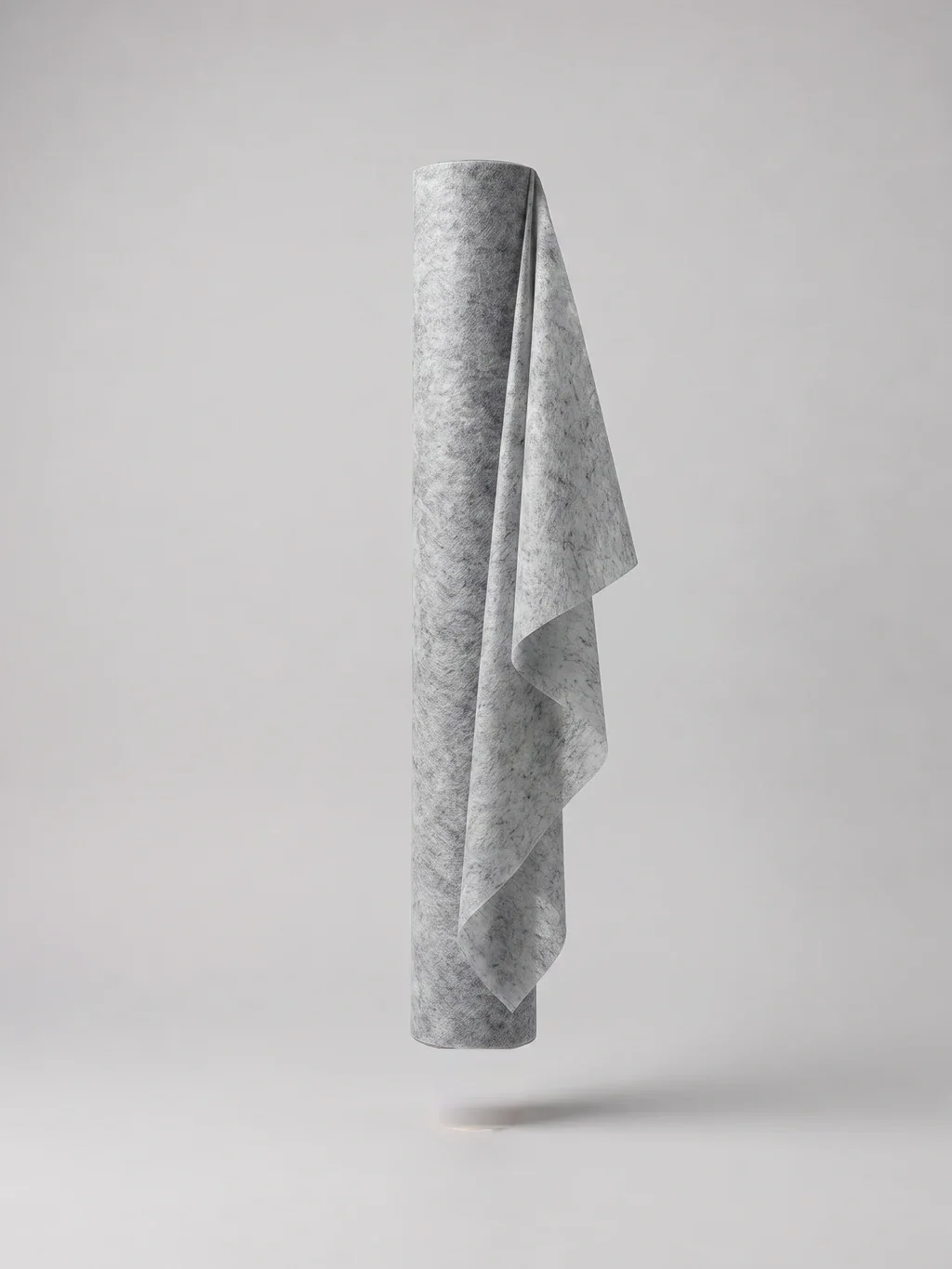
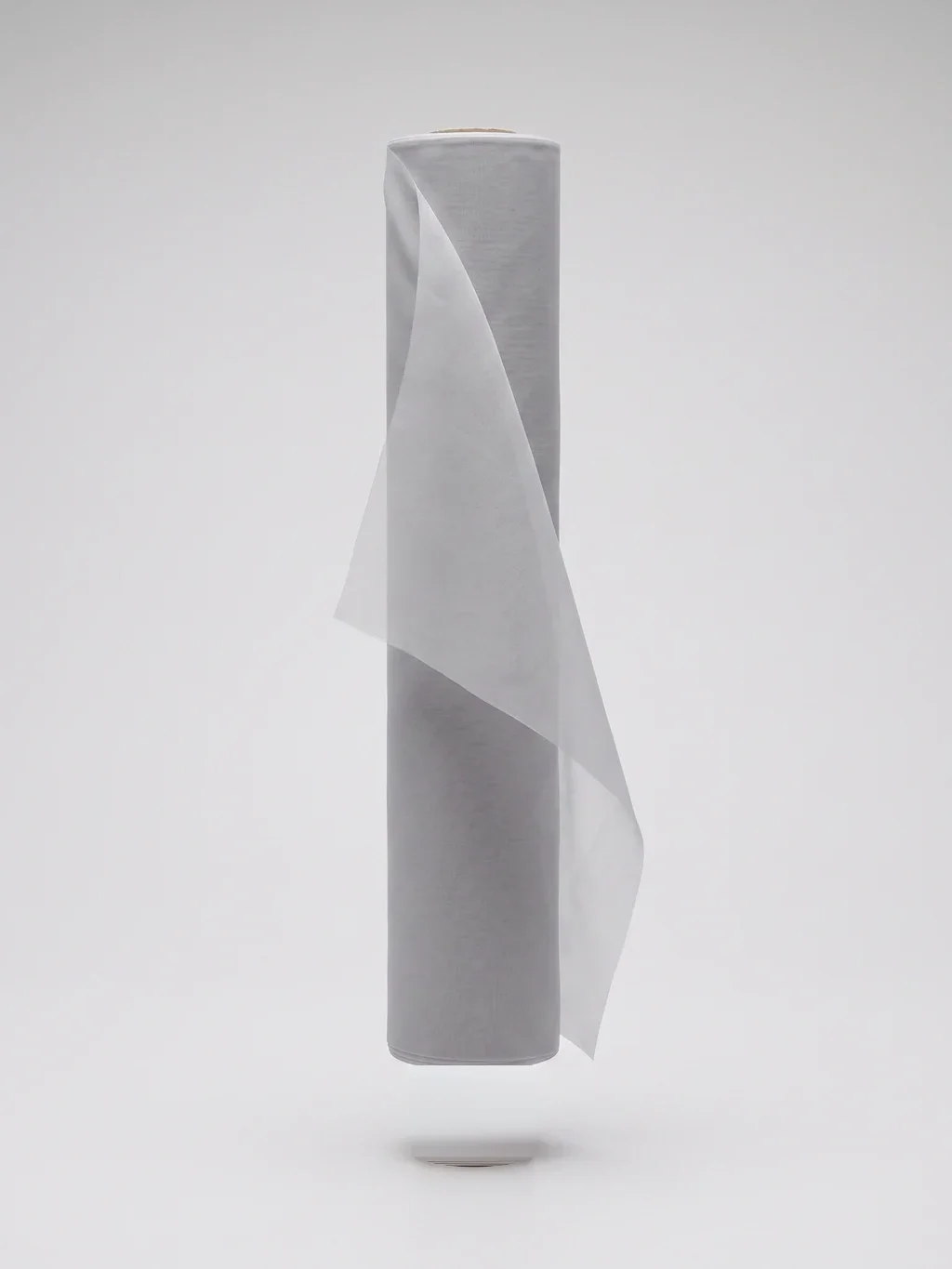
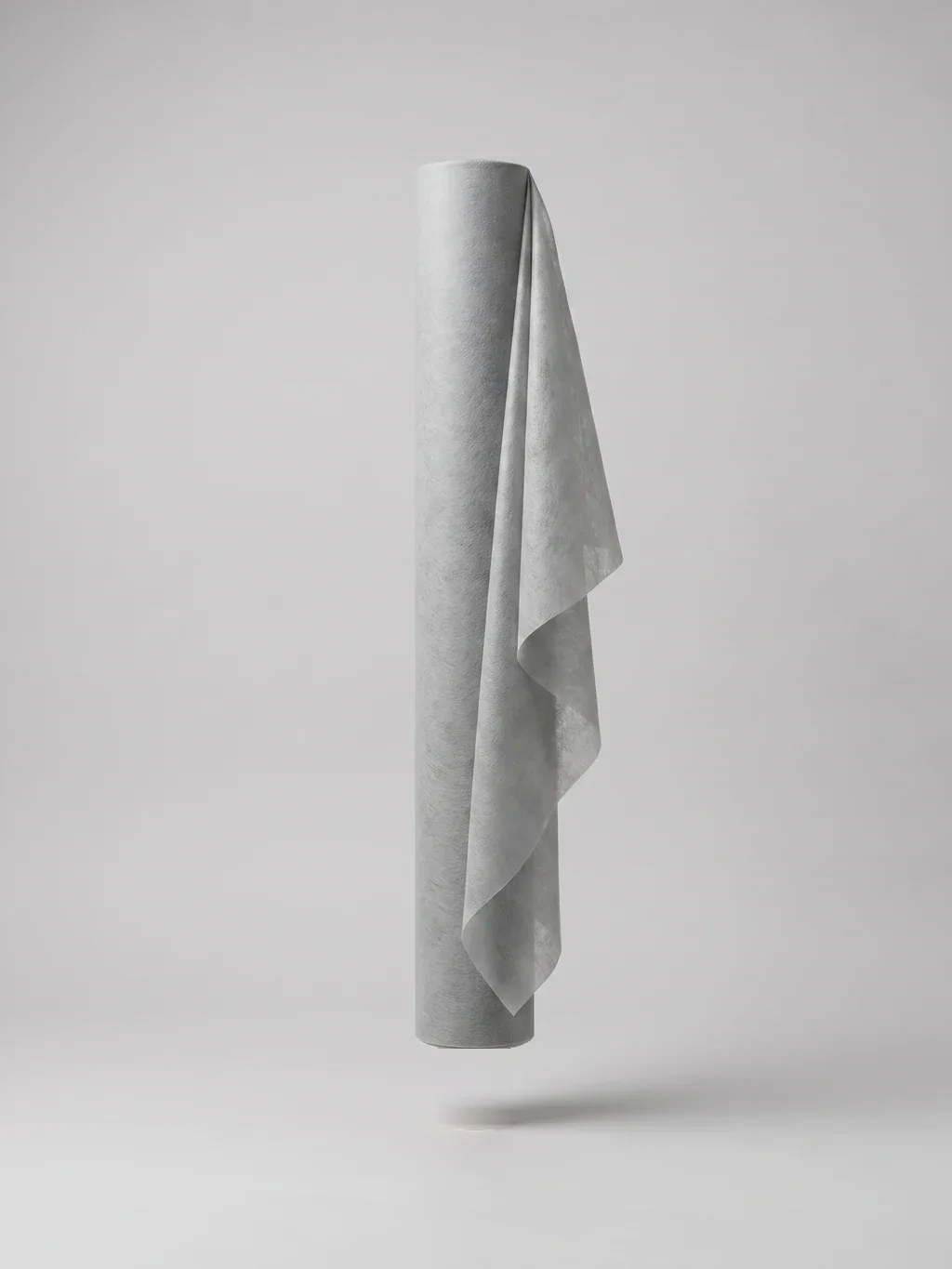
Corded jersey interlining: body without killing the stretch
Corded jersey interlining is a fusible on a knitted base with warp threads laid in; it gives body to stretch fabrics without killing the stretch. Here is what the knitted base does, what the laid-in threads solve, and the rules for interlining knitwear.
UB-IJ150 Updated
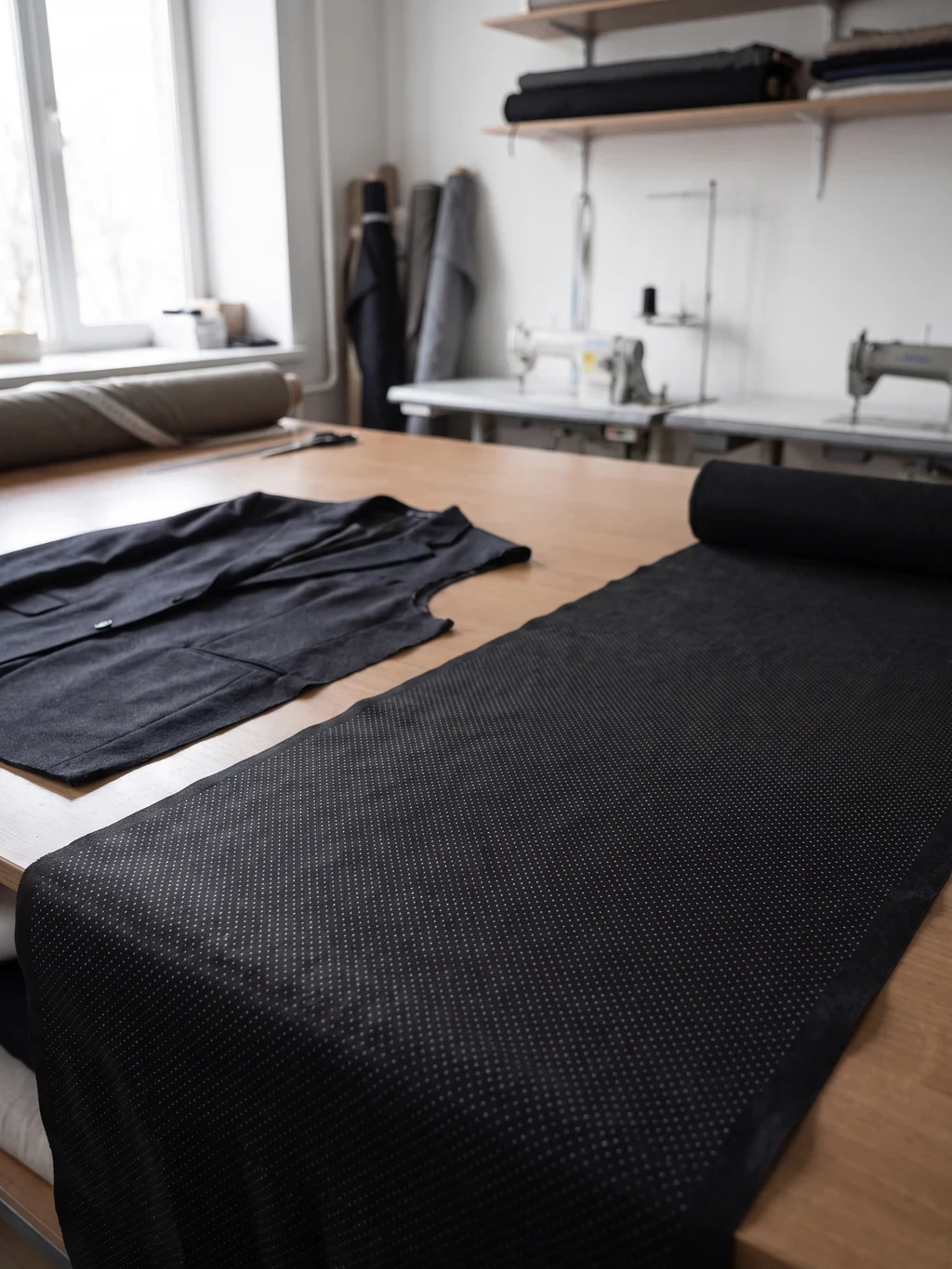
The problem first: how do you fuse to a knit?
A knitted cloth exists because it stretches. Following the body, moving with the wearer, not fighting when it is put on — all of that comes from the stretch.
But a knit still has places that need support: the neckline, buttonholes, button stands, pocket openings, the shoulder line. Left to itself the cloth stretches there and never comes back. The drooping neckline on a knitted jacket after a month is the classic sign.
Here is the difficulty: fuse an ordinary interlining to a knit and the stretch dies. The cloth no longer gives — but giving was the only reason it was knitted. The garment becomes uncomfortable, the seams are strained, and it fights when it is put on.
This is the clearest "wrong product" case in interlining. Fusing a non-woven to a knit is no different from turning the cloth into an ordinary woven.
The answer: a knitted base
The base of this interlining is neither non-woven nor woven — it is knitted. The interlining itself can stretch. Fused to the cloth, the two layers give together and recover together.
If that were the whole story we would be finished. But a knitted base stretches in every direction, and that raises a different problem: there is no support. An interlining that gives in all directions holds the cloth nowhere.
This is where the "corded" part comes in. Straight threads are laid into the knitted base along its length — not knitted in, but laid between. The result: the cloth holds along the length and goes on stretching across the width.
Two directions, two behaviours
What comes out of that is exactly what a knitted garment wants:
| Direction | Behaviour | What it buys |
|---|---|---|
| Lengthways | Holds, does not stretch | The neckline does not droop, the buttonhole line stays put |
| Crossways | Stretches | The garment does not fight when it is put on |
| Bias | Gives partly | Follows curved lines |
In practice that means: fuse the front of a knitted jacket with this and the jacket does not drop, but it still behaves like a knitted jacket on the body. The gap with full-width interlining is exactly here — that one locks both directions, this one locks only one.
Orientation: the detail that decides everything
With this interlining one mistake wipes out the whole benefit: laying it the wrong way round.
The direction it holds is the length. That has to line up with the direction the cloth needs to hold. Laid the other way, two things break at once: the cloth stretches where it should hold, and locks where it should stretch. The result is a garment that both droops and fights when it is put on.
- Mark the thread direction of the interlining before cutting.
- On necklines and fronts, the thread direction should run lengthways along the garment.
- Test on an offcut: after fusing, pull it both ways and feel which one holds.
- Lay the interlining the same way as the cloth on the marker.
Checking the direction takes thirty seconds. A batch fused the wrong way round is not noticed until somebody puts the garment on — and at that point there is no way back.
Where it is used
| Where | For what | Note |
|---|---|---|
| Knitwear necklines | Stopping the droop | The most common use |
| Knitted jacket fronts | Giving form | The stretch is preserved |
| Buttonholes and button stands | Keeping the cloth from opening | A small piece is enough |
| Pocket openings | Stopping the stretch | Can be cut into strips |
| Knitted dress shoulders | Carrying the load | Can be used with Terfix tape |
Where it is not used is equally clear: woven cloths. On a woven there is no stretch to preserve, and body interlining or paper interlining both gives more support and is easier to work with.
Fusing: what is different about a knit
A knit stretches under the press, and a piece fused while stretched recovers as it cools — tension is left between interlining and cloth, and the surface puckers.
- Lay the piece in the press as it falls, without pulling it out.
- Keep the pressure low. High pressure crushes and spreads a knit.
- Keep the heat low; knitted cloths are often synthetic blends and heat sensitive.
- Let the piece cool completely flat after fusing; moving it hot deforms it.
- Test after cooling: pull the piece across the width and make sure the stretch is still there.
That last point matters. The standard fusing test checks that the bond holds; here there is a second test — whether the stretch survived. No batch starts until both pass.
Common mistakes
- Fusing a non-woven to a knit. The stretch dies and the garment loses its purpose.
- Laying the interlining the wrong way round. The cloth holds in the wrong direction and gives in the wrong direction.
- Stretching the piece into the press. It puckers as it cools.
- Running the pressure high. The knit is crushed and its surface flattens.
- Doing only the bond test. The stretch test has to be passed too.
When you order
150 cm wide, 100-metre rolls, in black and white.
Tell us which knitted cloth you are working with. Knits vary enormously in how much they give, and how the interlining behaves with yours can only be seen by trying it.
You can ask for a small piece to test with. Fusing one collar and pulling it both ways settles the decision in five minutes.
Samples, stock and delivery are settled on the phone.
Frequently asked questions
Can an ordinary interlining be fused to a knit?
It can, but the stretch dies. The cloth no longer gives, the garment fights when it is put on, and the seams are strained. A knit is knitted for one reason — so that it stretches — and locking that turns the product into something else.
What does "corded" mean here?
That straight threads are laid into the knitted base along its length. They are not knitted in, they lie between. The result is a cloth that holds lengthways and goes on stretching across the width — exactly what a knitted garment wants.
Which way should the interlining be laid?
The thread direction of the interlining has to match the direction the cloth needs to hold — on necklines and fronts that is usually the length of the garment. Laid the other way, the cloth holds in the wrong direction and gives in the wrong direction. Fuse an offcut, pull it both ways and check by hand.
Can it be used on a woven fabric?
It can, but there is no reason to. On a woven there is no stretch to preserve, and body interlining or paper interlining gives more support and is easier to work with.
How long is a roll?
100 metres, 150 cm wide. If you need a smaller quantity, let us talk it through on the phone.