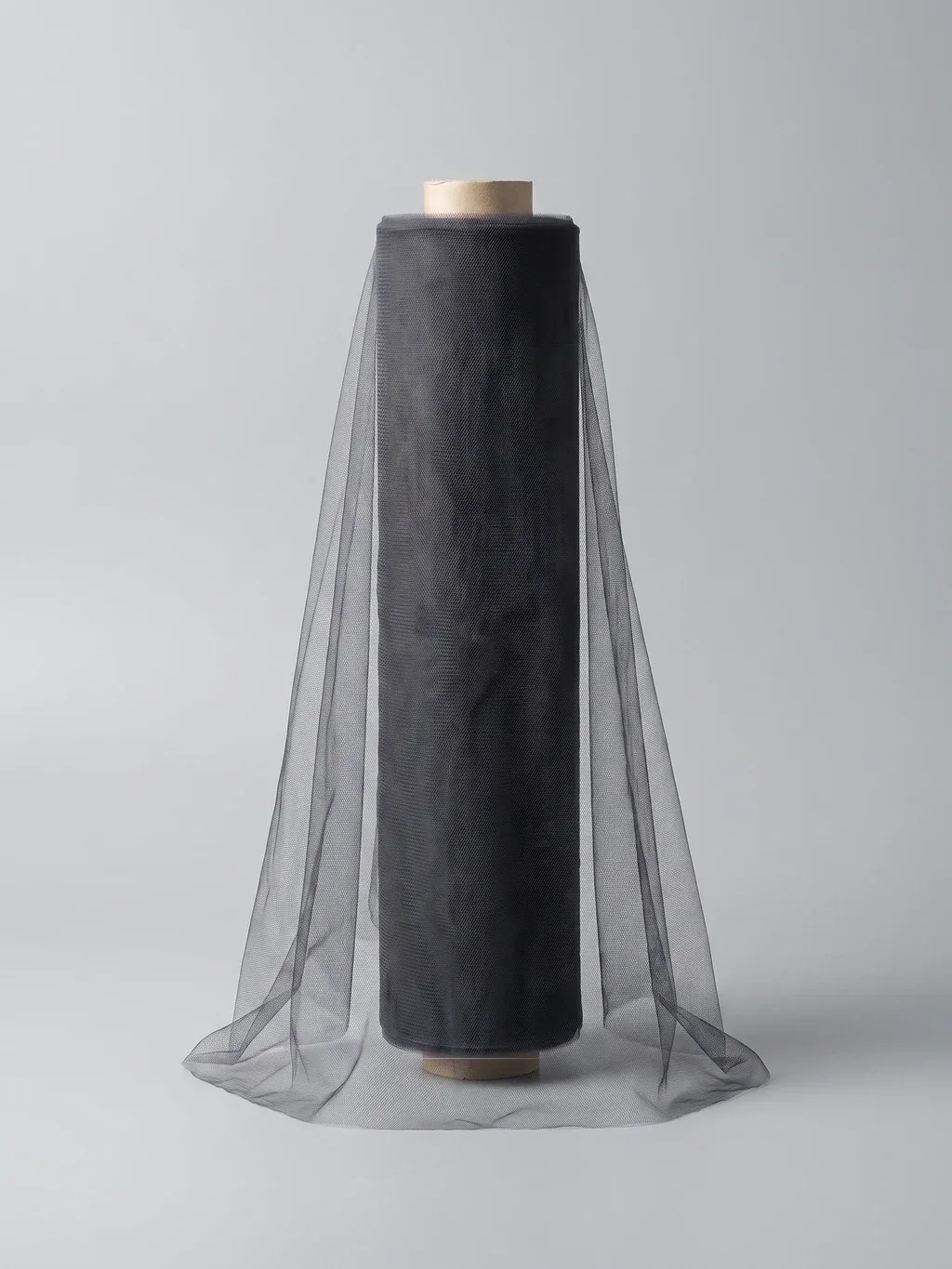
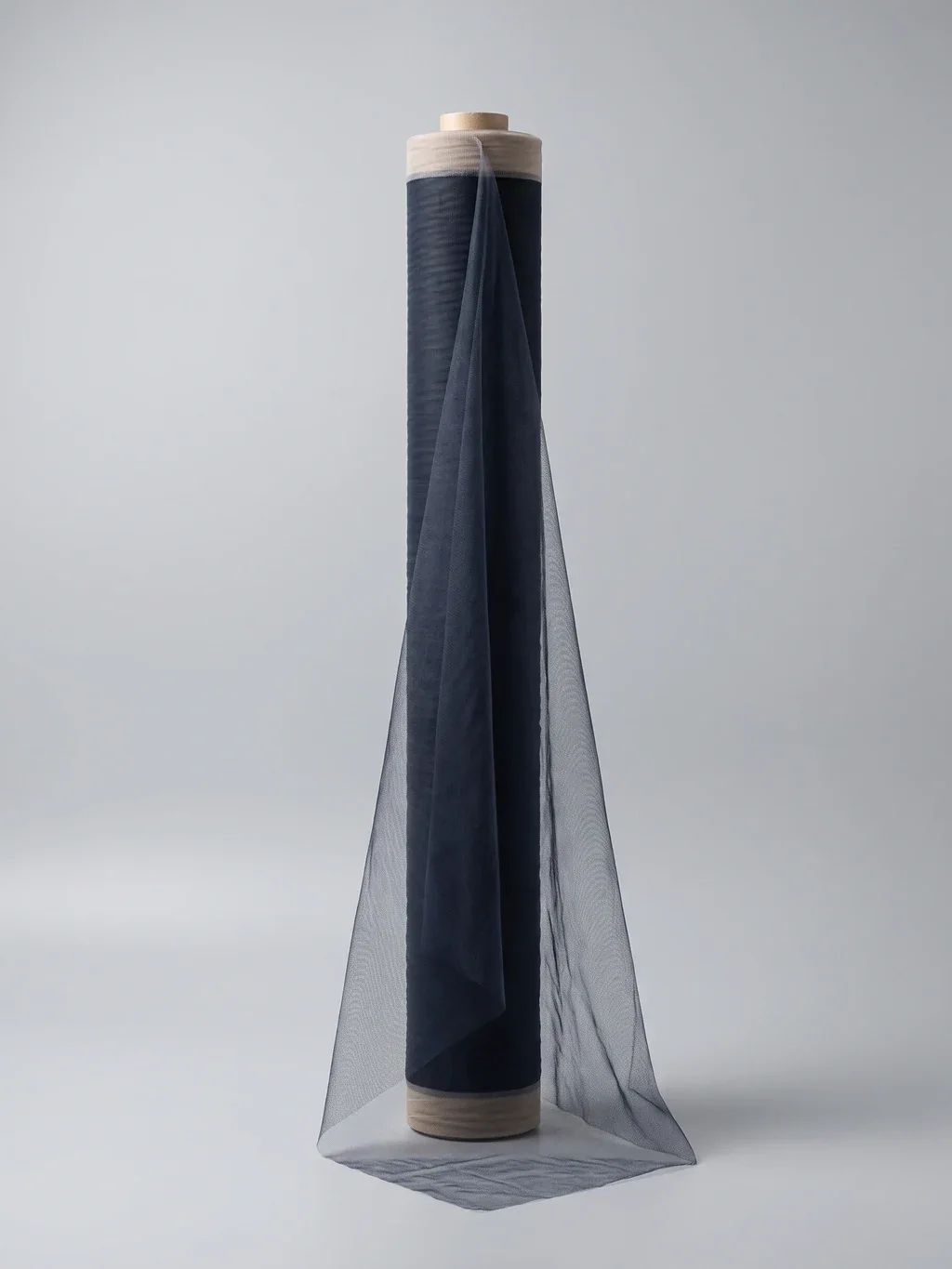
Crystal tulle: what actually holds a full skirt out
Crystal tulle is a crisp tulle with a bright surface, used where a full skirt or a puff has to keep its shape. Here is where the crispness comes from, the logic of building volume from underneath, and what to watch when working with a stiff mesh.
UB-KR050 Updated
What is crystal tulle?
Crystal tulle is a mesh — the same basic structure as Hayal tulle. What separates it is its stiffness and the sheen on its surface.
The stiffness comes from two places: a heavier, more resistant yarn, and the finish applied to the cloth. The result is a surface that stands up by itself in the hand. Put a piece down on a table and it does not lie flat, it lifts slightly — the crispness is that concrete.
Ours comes in 50-metre rolls with no limit on colour. The "crystal" in the name is about the glint on the surface: unlike a matt tulle, it reflects light.
What the stiffness is for
A skirt standing full is not simply a question of how much cloth is in it. However much soft cloth you add, it comes down under its own weight. For fullness, the cloth has to push outwards.
That is exactly what a crisp tulle does. Because it resists more strongly than its own weight pulls, it does not drop — it opens outwards. One layer of crisp tulle gives more volume than five layers of soft tulle, and stays far lighter doing it.
- It gives volume in a single layer, so the layer count stays low.
- It stays light; in bridal, weight is directly a comfort issue.
- It holds its form; worn all day, the skirt does not collapse.
- It recovers after washing and after being packed.
Fullness is not "more cloth", it is "stiff cloth in the right place". Once that lands, both the material and the weight come down.
Building the volume from underneath
The most common way of working in eveningwear and bridal is to combine the two tulles as layers. The logic runs like this:
| Layer | Material | Its job |
|---|---|---|
| Underskirt / bottom layer | Crystal tulle | Builds the volume, pushes the skirt out |
| Middle layers | Crystal or Hayal tulle | Softens the transition |
| Visible top layers | Hayal tulle | Gives the soft look |
| Lining against skin | Satin or polyester lining | Stops the crisp tulle prickling |
The advantage of that arrangement: from outside the skirt looks soft, but its form is carried by a crisp layer underneath. Build the same volume from Hayal alone and you would need far more layers, and the skirt would collapse over the course of the day.
Against the skin: the lining question
The best-known problem with crisp tulle is that it prickles. The cut edges of a stiff mesh are sharp and irritate skin they rub against. In a wedding dress worn for hours, that is not a small detail.
- Crisp tulle should never touch skin directly.
- A lining or a soft layer goes underneath it.
- The waistband and the top of the skirt need particular attention.
- Cut edges can be turned to face inwards.
This is why crystal tulle nearly always lives in a layer nobody sees. If it is used on a visible surface, it goes either somewhere away from skin — a skirt hem, the outside of a sleeve — or with a layer beneath it.
Working with a crisp mesh
Compared with soft tulle, crisp tulle is easier to cut and harder to sew. It does not slide, so it behaves in the lay; it does not bend, so it fights at the machine.
- Cutting: because it does not slide, the ply count can run a little higher than with soft tulle.
- The cut edge needs no finishing — tulle does not fray.
- Needle: 80/12, sharp point. A stiff mesh takes a heavier needle.
- Stitch length: 2.5 – 3 mm.
- You may need to raise the presser foot pressure; crisp tulle escapes from under the foot.
- It folds on the way into the machine; on large pieces a second pair of hands helps.
Crisp tulle gathers differently too: it draws up less and gives more volume. The same gathering ratio that produces a waved skirt in soft tulle produces a full one in crisp tulle. The arithmetic has to be built accordingly.
Where it is used
| Where | For what | Note |
|---|---|---|
| Underskirt / petticoat | Building the volume | The most common use |
| Full skirts | Carrying the form | Under the visible layer |
| Sleeves and shoulders | Volume in the sleeve | Must not touch skin |
| Trims and bows | Detail that keeps its shape | One layer is enough |
| Collars and capes | An upstanding form | Adds no weight |
Storage and pressing
Crystal tulle does not crease, which is an advantage, but it does lose its form temporarily when it is compressed. Left folded for a long time, a crease line can appear.
- Store rolls flat, not on end.
- Hang finished skirts rather than folding them.
- If pressing is needed, very low heat and always a press cloth; a synthetic mesh melts.
- For crease lines, steam is usually enough — hang the tulle and pass steam from a distance.
A soleplate touching crisp tulle melts it in seconds, and melted mesh does not come back. If in doubt, keep the iron away entirely and work with steam.
Common mistakes
- Letting crisp tulle touch skin directly. In a garment worn for hours it irritates.
- Trying to build the volume from soft tulle. The weight climbs and the skirt collapses during the day.
- Working out the gathering as if it were soft tulle. Crisp tulle gives far more volume at the same ratio.
- Touching it with the soleplate. The mesh melts, with no way back.
- Storing it folded for a long time. Crease lines appear.
When you order
Rolls are 50 metres, with no limit on colour. Call for the width.
Tell us which layer it is for — an underskirt and a visible layer can want different degrees of stiffness.
Metreage depends on the gathering ratio. Describe how full you want it and we can work out the metreage together.
Samples, stock and delivery are settled on the phone.
Frequently asked questions
What is the difference between crystal and Hayal tulle?
How they stand. Crystal is crisp; it stands outwards and gives volume in a single layer. Hayal is soft; it falls downwards and builds volume through layers. Most evening dresses use both: volume underneath from crystal, visible surface from Hayal.
Crisp tulle prickles against the skin. What can be done?
It should never touch skin directly. A lining or a soft layer goes underneath. The waistband and the top of the skirt need particular attention; in a dress worn for hours that detail decides the whole comfort of the garment.
Why does one layer of crystal give more volume than five of Hayal?
Because volume comes from the cloth pushing outwards, not from the amount of cloth. Soft tulle comes down under its own weight; crisp tulle resists and opens out. That is why a skirt built with crystal is both fuller and lighter.
Can it be pressed?
A soleplate melts a synthetic mesh in seconds, with no way back. If you must press, use very low heat and always a press cloth. For crease lines, hanging it and steaming from a distance is usually enough.
How long is a roll?
50 metres. Call for the width and colour options.