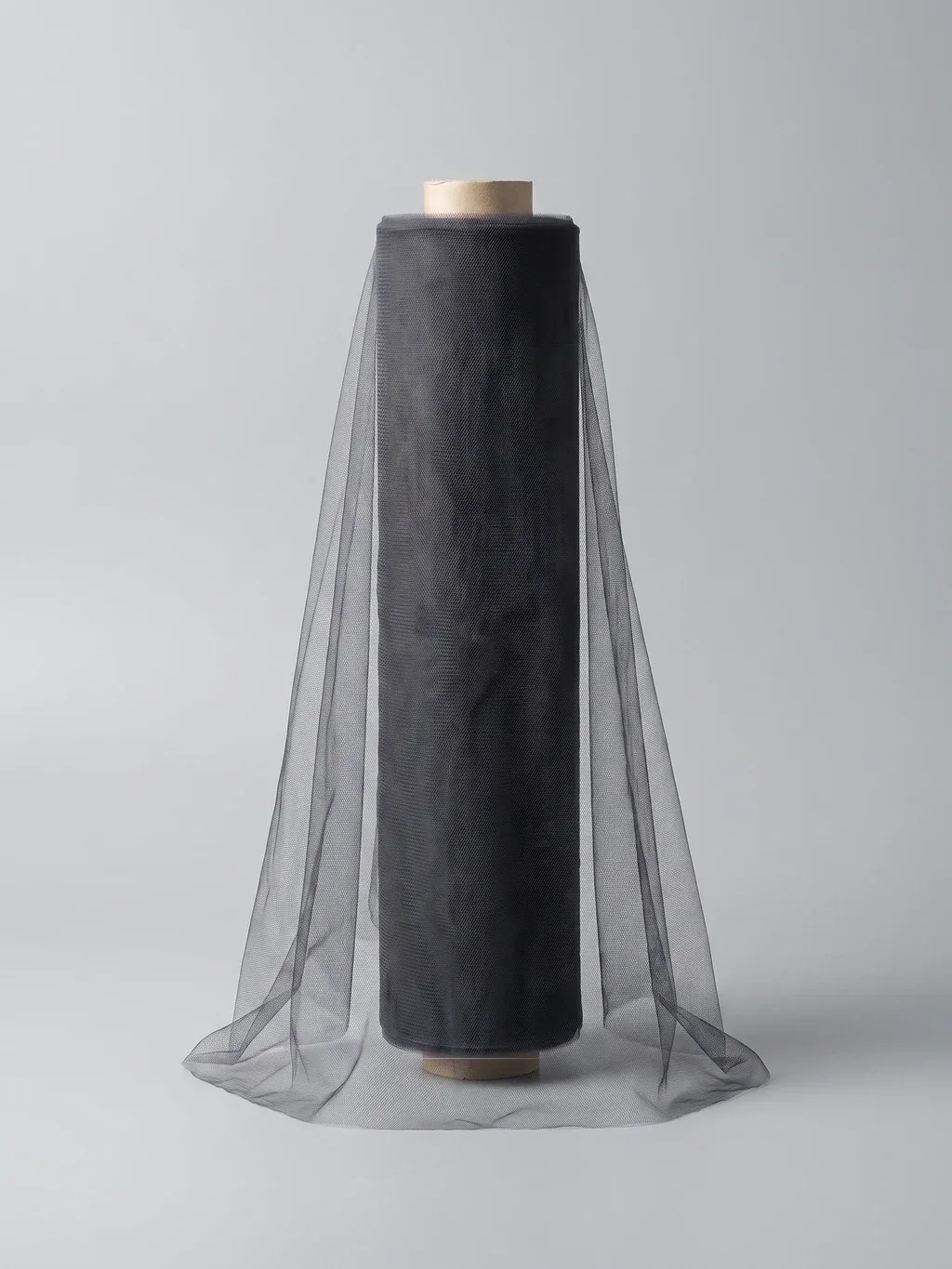
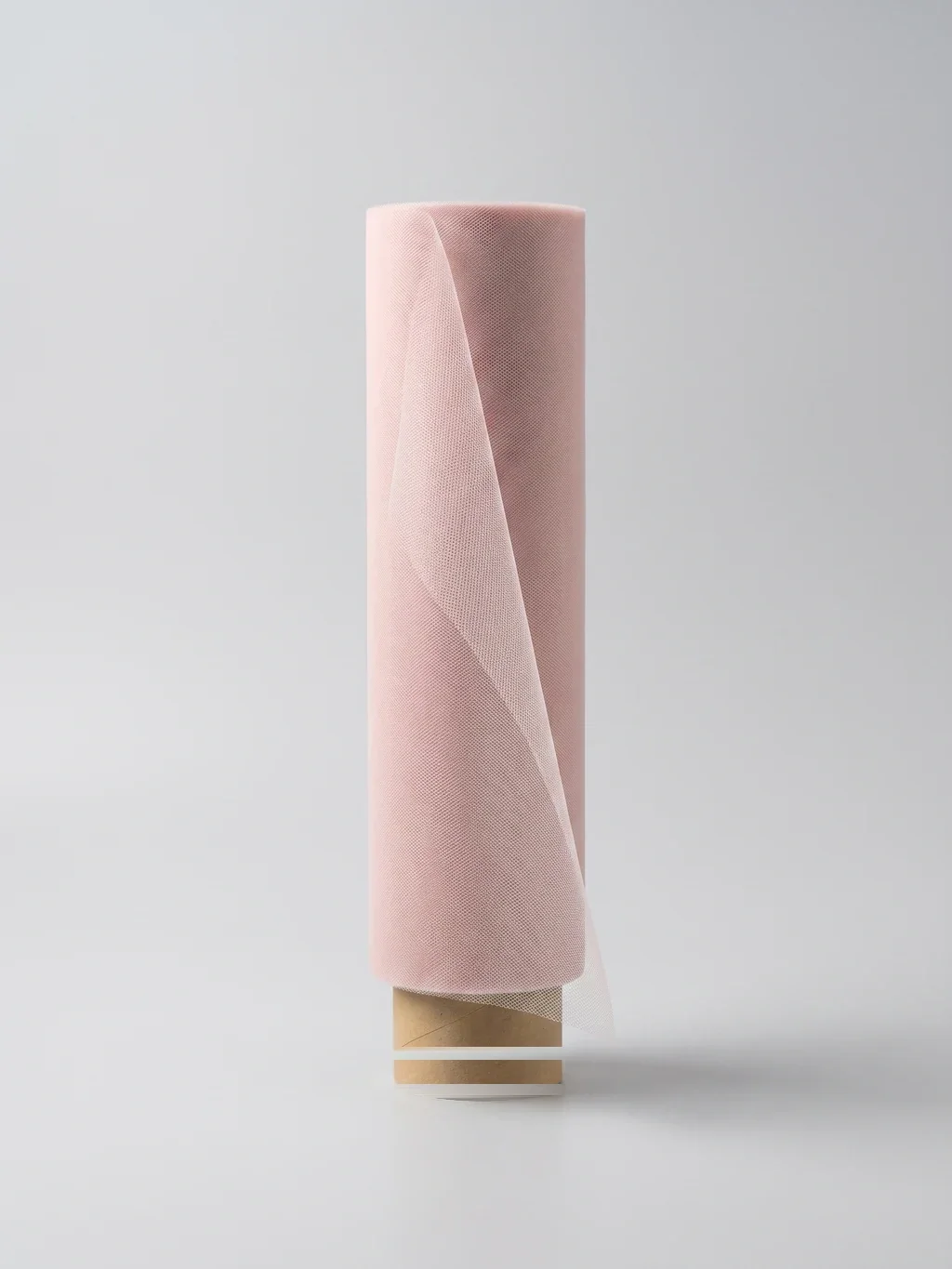
Stretch tulle: how an invisible lace join is made
Stretch tulle is a mesh that gives; it is used on close-fitting panels and wherever lace has to be joined. Here is how the stretch gets into a mesh, the invisible-join technique, and why this material is indispensable in lingerie.
UB-SR150 Updated

What is stretch tulle?
Stretch tulle is a mesh that gives. What separates it from ordinary tulle is elastane in its structure: the holes open when the cloth is pulled and close again when it is released.
That is the fundamental difference. Hayal and crystal tulle do not stretch — pull them and the holes open and stay open. Stretch tulle recovers, which is why it can be used on close-fitting panels.
Ours is 150 cm wide, in 100-metre rolls, in a wide colour range. Unlike eveningwear tulle it mostly moves in skin tones and dark tones — its uses push it there.
Two-way or four-way?
In stretch fabrics, how many directions the stretch runs in decides where the piece can be used.
| Two-way | Four-way | |
|---|---|---|
| Stretch | One direction, usually across | Both across and along |
| Fit | Enough on straight lines | Sits on the curves of the body |
| Where | Waistbands, straight strips | Bodices, lingerie, activewear |
| Cutting direction | Critical — cut wrong, the stretch is lost | More forgiving |
This is worth asking about when you order, because two cloths under the same name can differ. Making a close-fitting panel, you want four-way; for a waistband or a straight strip, two-way is enough.
In a two-way stretch cloth, cutting direction is as critical as it is with satin lining. A piece cut the wrong way holds where it should give, and the garment will not go on.
The invisible join: what this cloth is really for
There is a recurring problem in lingerie and eveningwear: finishing the edge of a lace piece, or joining two pieces of lace. Do it with a plain seam and the stitch line shows and the lace motif is cut through.
The answer is stretch tulle. The lace is laid on the tulle and stitched following the outline of the motif. The tulle outside the stitching is then cut away. What is left is a join that finishes with the lace's own edge and shows no seam.
- Lay the lace over the tulle and pin it.
- Follow the outer line of the motif with a fine zigzag or an overlock stitch.
- Trim away the tulle outside the stitching.
- If needed, cut away the tulle under the lace as well, so the lace stands alone.
For the technique to work, the tulle has to carry three properties at once: it has to stretch (so it moves with the lace), be transparent (so it does not show), and not fray (so it stays where it is cut). Stretch tulle does all three.
Why this cloth in lingerie
What lingerie asks of a material looks contradictory: it must be light, it must stretch, it must breathe, and at the same time it must hold.
- Lightness — most of a mesh is air; the cloth is barely felt.
- Stretch — elastane lets it follow the body without restricting movement.
- Breathability — the holes pass air directly.
- Hold — its resistance to being stretched lets it support in specific places.
That last point matters: tighter, more resistant versions of the same mesh act as support. A soft stretch tulle works as an overlay, while a firmer one becomes a shaping layer. Which one you need is worth saying when you order.
Sewing stretch tulle
Sewing a stretch cloth while keeping the stretch is a job with its own rules. A plain straight stitch does not work here: when the cloth gives, the stitch does not, and the thread breaks.
- Stitch type: zigzag, overlock or a stretch stitch. If a straight stitch is used, set it as a very narrow zigzag.
- Needle: 70/10 or 75/11, ball point. A sharp point cuts the elastane.
- Thread: a polyester thread with some give.
- Drop the presser foot pressure; high pressure stretches the cloth as it feeds.
- Do not pull the cloth through. A piece sewn under tension gathers when it is released.
The ball-point question is critical here. A sharp needle cuts the elastane in the mesh outright, and a ladder starts from the cut — running along the mesh and taking the piece out of use. A ball point passes between the threads instead of cutting them.
Once a ladder has started there is no stopping it. Using the right needle is one rule that saves a batch on its own.
Colour: the skin-tone question
The uses of stretch tulle push it towards particular colours. In lingerie and in "invisible" joins the tulle must not be noticed, which means skin tone.
But there is no single skin tone. The same cloth disappears on one person and reads clearly on another. That is why the skin-tone family usually exists in several steps.
- Choose the tone thinking about who will wear it; one tone does not cover a range.
- In a lace join, choose the tulle against the skin or lining beneath, not against the lace.
- Black and dark tones are the safest choice for a lace join — on a dark ground the tulle disappears anyway.
- Ask for a sample for tone. Skin tones almost never read correctly on a screen.
Common mistakes
- Sewing with a sharp needle. The elastane is cut, a ladder starts and runs.
- Using a plain straight stitch. The thread breaks when the cloth gives.
- Pulling the cloth through the machine. The piece gathers when it is released.
- Cutting a two-way cloth the wrong way round. It holds where it should give.
- Choosing a skin tone from a screen. It almost never lands.
When you order
150 cm wide, 100-metre rolls, in a wide colour range. Say three things when you order: how many directions the stretch has to run in, whether the tulle is a support layer or an overlay, and the colour.
If you are working in skin tones, ask for a sample. In this group the tone decision is made by eye and a photograph will not do.
If you are joining lace, bring a piece of the lace you will use; the stretch of the tulle has to suit it.
Samples, stock and delivery are settled on the phone.
Frequently asked questions
What is the difference between stretch tulle and ordinary tulle?
The stretch. Stretch tulle has elastane in its structure: it extends when pulled and recovers when released. Hayal and crystal tulle do not — pull them and the holes open and stay open. That is why only stretch tulle can be used on close-fitting panels.
How is an invisible lace join made?
The lace is laid over the stretch tulle and stitched with a fine zigzag following the outer line of the motif, then the tulle outside the stitching is trimmed away. What remains is a join that finishes with the lace's own edge and shows no seam. It works because the tulle is transparent, stretches, and does not fray.
Why does it have to be a ball-point needle?
A sharp needle cuts the elastane in the mesh outright. A ladder starts at the cut and runs along the mesh, taking the piece out of use. A ball point passes between the threads instead of cutting them. There is no stopping a ladder once it has started, which is why the needle choice alone can decide a batch.
Should I ask for two-way or four-way?
For a close-fitting panel — a bodice, lingerie, activewear — you want four-way. For a waistband or a straight strip, two-way is enough. With two-way, cutting direction is critical: a piece cut the wrong way holds where it should give.
How long is a roll?
100 metres, 150 cm wide. If you need a smaller quantity, let us talk it through on the phone.